
ComicFire guide
Brand Storytelling with Comics
How do you tell someone your café is welcoming? Give them a rainy afternoon, an open door, and three panels.
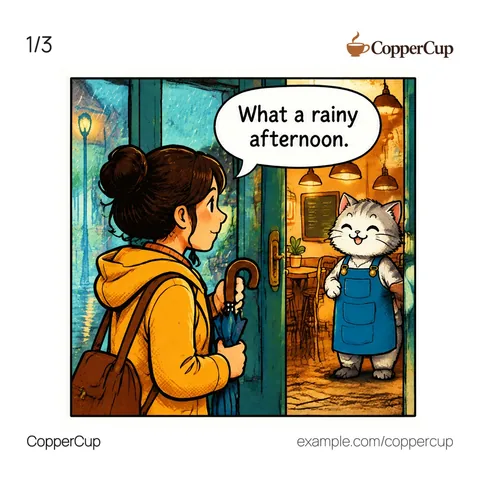

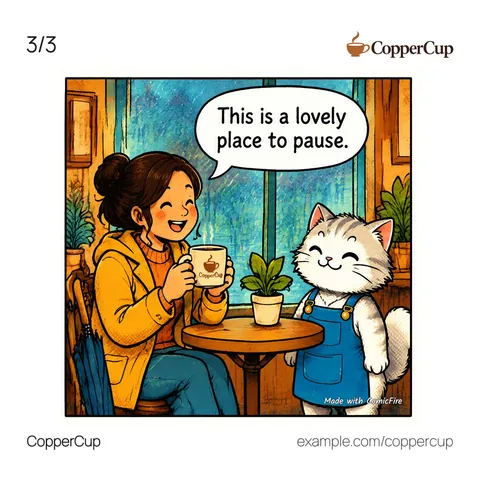
What did you learn about CopperCup? You saw the welcome before anyone had to describe the service. Try taking away the second panel. A guest arrives cold and somehow ends up comfortable. Mocha’s gesture is what makes this a story about the café.
I’ve always been fascinated by the ways a chart, a picture, or a comic can help someone see what you mean. That’s what drew me to building ComicFire. A short strip forces a useful decision. Which part of your business can the reader actually see someone experiencing?
Write your own three-panel strip
Start with one question a customer has actually asked. Write the plain answer in a sentence. Keep that sentence handy. You’ll use it to check whether the comic still tells the truth.
- Situation. Who needs something, and where are they when they need it? “A guest turns up in the rain” gives an illustrator more to work with than “Our café cares.”
- Action. What does someone do that makes the brand’s promise visible? Give the character one gesture the reader can follow.
- Change. What can the reader see now that they couldn’t see in panel one? End there. The product catalogue can wait.
Try it on paper. “When ___ happens, my customer wants ___. Our character ___. By the last panel, ___.” Read it to someone unfamiliar with your business and ask what changed.
One character, two customer questions
Take Mara, a fictional founder explaining scheduled backups. Episode one. Mara puts off backing up a file. When the file goes missing, an overnight copy gives her something to recover. The point is the value of a schedule. Details about storage belong in the instructions.
Episode two. Mara can see a saved copy. Can she open it? Show her restoring the file and checking the contents. The familiar character lets you spend the next three panels on a different idea: a backup is worth testing. Both episodes are teaching examples.
What can a brand comic do?
Give someone a reason to pause
Dhanesh, Duthler and Li examined 400 visuals posted by four airport brands. Narrative qualities were associated with greater engagement. The researchers observed existing posts, so the study can’t tell us how the same message would have performed as a comic. For your strip, ask what a reader can notice in the first panel. Airport-brand study
Give them something worth passing on
Berger and Milkman found that practical usefulness and emotions that stir people to act mattered for online sharing. Their work included news articles and experiments. Who might forward your strip to a colleague, and what would it help that colleague do? A separate analysis of 1,247 Reddit images connected predicted image memorability with comments. A comment is a different outcome from a share. Sharing research · Reddit image study
Help the reader connect a character to the brand
Imagine remembering the cat and forgetting the café. The association between Mocha and CopperCup is something the audience has to learn. Romaniuk’s work on distinctive brand assets explains why consistent cues matter. System1’s account of M&M’s advertising illustrates the idea, although the ads also differed in their stories. Brand assets framework · Industry example
Make an explanation easier to follow
Jun Liu studied English-language learners reading texts with and without comic strips. Lower-proficiency readers recalled more of a difficult text when they had comic support. Higher-proficiency readers tackling that text didn’t show the same benefit. Choose a sequence when seeing the action adds information. A table may serve a price comparison better. Reading comprehension experiment
Did they remember the café?
If you want to learn whether the strip helped, give it something fair to compete with. Randomly assign comparable readers to see the strip or a plain-language version of the same message. Match the brand exposure, channel, and time available. After the same delay, ask both groups the same questions in the same order.
- Unaided brand recall
- “Which café was the story about?” Leave the answer open. Score the share who name CopperCup correctly. Ask this first, while the name is still theirs to retrieve.
- Aided recall and recognition
- Offer a cue such as “Its name starts with C” and see who can now supply the name. If you show a list of café names instead, you’re measuring recognition. Record which question you used.
- Brand linkage
- Show Mocha with the café name and logos removed. “Which business do you associate with this character?” Count correct and mistaken attributions. Remembering the cat alone tells you little about the café.
- Message comprehension
- Ask “What did the café do for its guest?” Decide beforehand what counts as understanding the message. An answer about a warm welcome tells you more than a like.
- Engagement and sharing
- For every 100 people the post reached, how many reacted or commented? How many shared it? Record those rates separately. Note any differences in paid promotion, placement, or timing.
- Brand associations and equity
- Across several episodes, track whether people associate “welcoming” with CopperCup and whether they would consider visiting. These are pieces of customer-based brand equity. A single successful post can’t establish its value. Keller’s framework
- Net Promoter Score (NPS)
- Ask customers how likely they are to recommend the business on a 0–10 scale. Subtract the percentage scoring 0–6 from the percentage scoring 9–10. Service, price, and the drink itself can shape that answer. I’d use recall or comprehension to judge this particular strip. Bain’s NPS definition
Report the denominator. Suppose 12 of 30 comic readers and 9 of 30 text readers name the café. That’s 40% versus 30%, a difference of 10 percentage points. Those numbers are invented to show the calculation. With groups that small, a few answers can change the result. Repeat the comparison before drawing a conclusion.
There is some advertising-specific evidence. In one print-ad experiment, participants responded more favorably to a brand represented by a cartoon spokesperson than by a human in the same ad. A retail survey of 147 respondents examined recognition of a comic-strip ad and found no evidence of short-term purchase. Neither study measured ComicFire customers or NPS. Print-ad experiment · Retail comic-strip study
From a customer question to the next episode
In ComicFire, describe the business and its audience, then give the recurring character a role. Review an idea, shape the script, and inspect the resulting comic. Check the lettering, the character, and every product claim before approving it. Download the approved asset pack and publish through your usual channels.
Keep a small record of the question, publication date, audience, reach, and the response you wanted to measure. For the next episode, keep the character recognizable and answer a different question. What’s the one thing about your business people keep asking you to explain?
See how ComicFire worksSources and further reading
- Dhanesh, Duthler & Li (2022). Social media engagement with organization-generated content. Observational study of airport-brand posts.
- Berger & Milkman (2012). What Makes Online Content Viral? News sharing and experimental evidence.
- Peng & Bainbridge (2026 issue). Image memorability predicts social media virality and externally-associated commenting. Analysis of Reddit posts.
- Jenni Romaniuk. Building Distinctive Brand Assets. Author’s book overview.
- Melissa Rosenthal, System1 (2024). Leveraging the Magic of Memorable Characters in Advertising. Industry account.
- Jun Liu (2004). Effects of Comic Strips on L2 Learners’ Reading Comprehension. Language-learning experiment.
- Kevin Lane Keller (1993). Conceptualizing, Measuring, and Managing Customer-Based Brand Equity.
- Bain & Company. Introducing the Net Promoter System (PDF)
- Heiser, Sierra & Torres (2008). Creativity via Cartoon Spokespeople in Print Ads.
- Rennae Daneshvary (1991). Recognition Effectiveness of Comic Strip Advertising for Small Retail Firms.
Adapted from Stories That Stick, by Mithun Shanbhag. First edition published by Skewed Ventures in September 2026.